


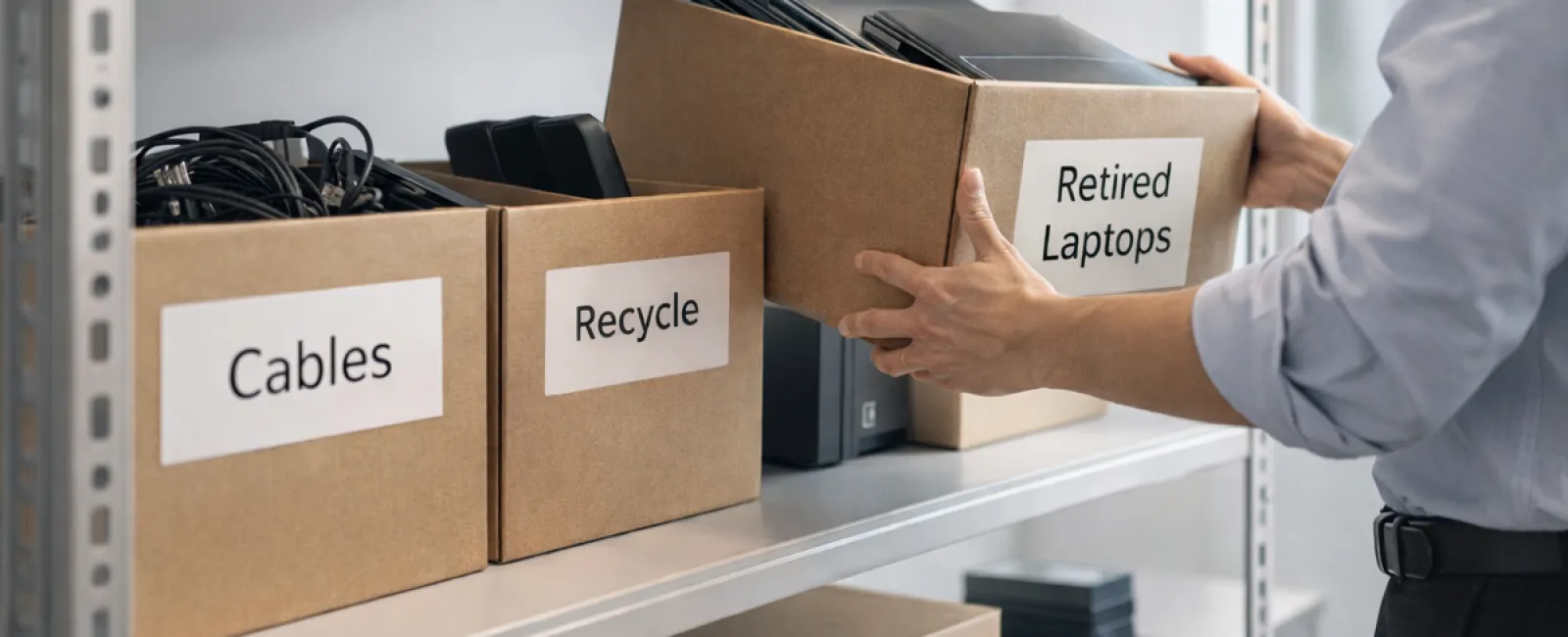
Most businesses kick off spring cleaning with closets, but the true clutter often hides beyond the racks.
That clutter might be on a server rack or tucked away in storage rooms, back offices, or piles marked "deal with later."
Piles of outdated laptops, retired printers, backup drives from multiple upgrades ago, and boxes of cables nobody wants to discard just in case.
Every business ends up accumulating these tech remnants.
The real question is: Do you have a clear strategy for what comes next?
Technology Lifecycle: Beyond the Purchase Date
New equipment typically arrives with a purpose: improved speed, stronger security, enhanced capabilities, or supporting company growth.
While many businesses strategize technology acquisitions, few actively plan for the retirement of old devices.
Often, retiring tech happens quietly—a device replaced and set aside until someone finally clears the clutter.
This is common.
What's less common is approaching tech retirement with the same purposeful intent as purchasing it.
Remember, old equipment holds residual value, recyclable parts, and potentially sensitive data. Left unmanaged, it can bog down operations and waste space.
Spring offers a perfect opportunity to evaluate: Which devices still serve us, and which are just taking up valuable real estate?
A Clear-Cut Plan to Streamline Your Tech
Turn the "maybe someday" talk into action with our straightforward four-step method.
Step 1: Comprehensive Inventory
Identify what's being retired: laptops, phones, printers, networking gear, or external drives. You can't manage what you don't know, and a quick inspection often uncovers surprises.
Step 2: Determine Each Device's Fate
Devices usually fit into three buckets: reuse (internally or via donation), recycle (through certified e-waste programs), or destroy (due to data security needs). The key is making deliberate decisions instead of letting hardware linger indefinitely.
Step 3: Proper Device Preparation
Discipline here pays off.
For reuse or donation, unregister devices from management systems, revoke user access, and ensure thorough data wiping—not just a factory reset. Deleting files or quick formatting merely hides data locations; it doesn't remove the data itself.
Blancco's study revealed that 42% of resold drives on eBay still contained sensitive data, despite sellers claiming proper wiping. Certified data erasure overwrites every sector and provides verification.
For recycling, always choose certified e-waste providers instead of dumpsters. Note: Retail programs like Best Buy's recycling cater only to household residents, not businesses.
Commercial equipment requires certified IT asset disposition (ITAD) services or business-focused recyclers with e-Stewards or R2 certification (searchable at e-stewards.org and sustainableelectronics.org). Your IT partner often handles this coordination.
If destruction is needed, opt for certified wiping or physical methods like shredding or degaussing, and keep detailed records: serial numbers, destruction method, dates, and responsible personnel.
This isn't about paranoia—it's about responsibly closing the loop.
Step 4: Document and Move Forward
Once devices leave your premises, know exactly where they went, how they were handled, and ensure all access was removed. Clear documentation helps eliminate lingering doubts.
Devices Often Overlooked
Laptops get top billing; other equipment requires attention too.
Phones and tablets might still harbor email access, contact lists, or authentication apps. While factory resets address much, certified mobile wipe tools provide deeper security. Many manufacturers offer trade-in options, even for older devices, often providing credit toward new gear.
Modern printers and copiers contain internal drives storing everything printed, scanned, copied, or faxed. When returning leased machines, get written confirmation that drives will be wiped or removed before redeployment.
Batteries are classified as hazardous waste by the EPA. In several states, it's illegal for businesses to throw rechargeable batteries in the trash. Remove them when possible, tape terminals to prevent shorts, and drop them off at certified locations. Call2Recycle.org offers a location map; Staples, Home Depot, and Lowe's commonly accept rechargeable batteries.
External drives and retired servers often linger in closets far longer than planned. While not inherently problematic, these devices deserve the same retirement process as others.
Recycling Right
April's Earth Day reminders are timely.
With over 62 million metric tons of e-waste produced annually and only 22% properly recycled, electronics must not end up in landfills. Batteries, monitors, and circuit boards deserve certified recycling. Many communities offer certified e-waste programs designed for this.
Proper tech retirement is efficient, eco-conscious, and strategically smart—you don't have to sacrifice security for responsibility.
It's also a compelling story to share on your business's social channels. Customers notice when companies handle tech responsibly, without fanfare.
Unlocking Bigger Possibilities
Spring cleaning isn't just about removal—it's about creating room to grow.
Clearing old devices is one part, but step back and ask: Is our technology ecosystem truly empowering our business goals?
While hardware cycles out, software, automation, and process design increasingly drive productivity and profits.
Properly retiring equipment is good housekeeping; aligning your entire tech stack with company vision keeps you competitive.
How We Support Your Success
If you already have a smooth retirement process, that's fantastic—it should be simple and routine.
But now's an ideal moment to evaluate the broader picture: Are your systems integrated? Are tools working in harmony? Is your technology fueling growth or just maintaining status quo?
We'd be happy to help you review your tech stack, systems, and processes to boost productivity and profits.
No checklists, no pressure—just a practical conversation about making technology work smarter for your business.
Click here or give us a call at 816-256-2595 to schedule your free 15-Minute Discovery Call.
Feel free to share if this insight benefits other business owners.
Spring cleaning goes beyond closets—it's about optimizing the systems powering your business.