


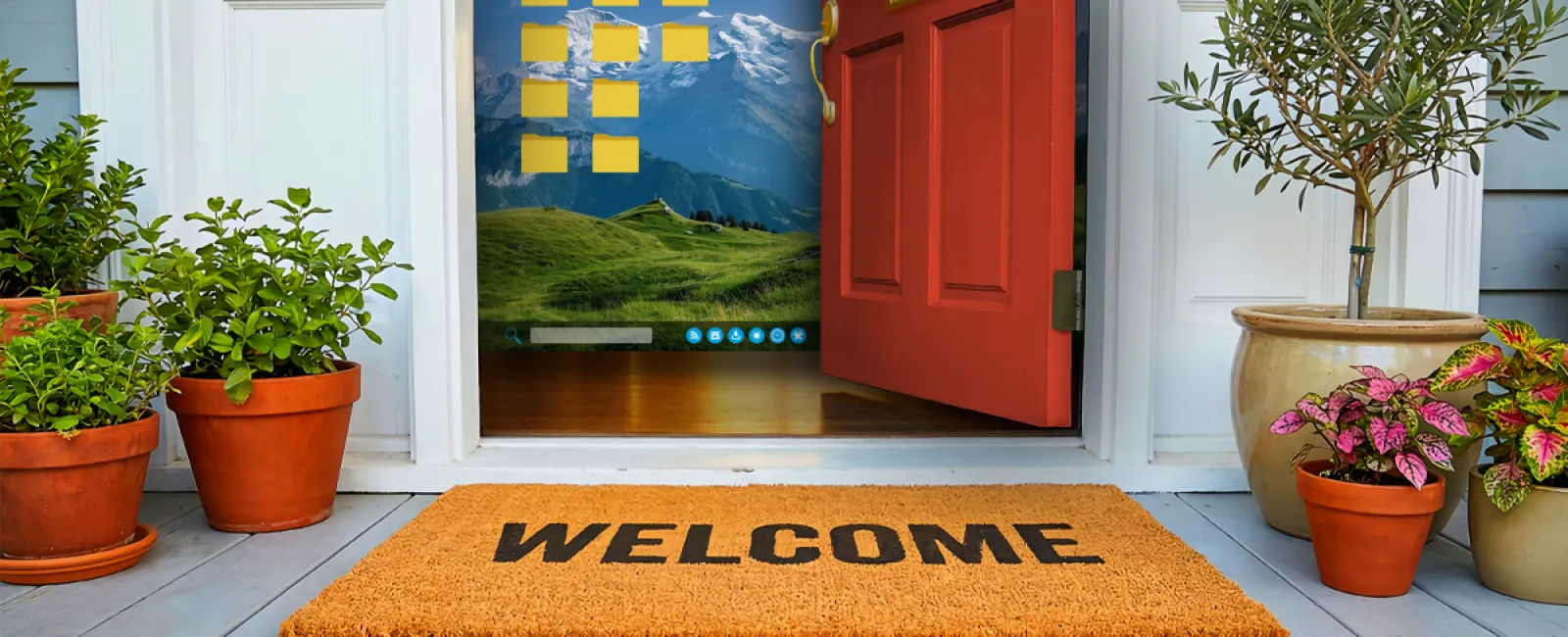
Imagine walking up to a house, pulling back the welcome mat, and finding the key sitting right there.
It feels easy, routine, and exactly where a thief would check first.
That is how many companies handle passwords.
Why password reuse is such a risk
Most breaches don't begin inside your organization. They start somewhere else entirely: a retail site, a delivery app, or an old subscription account you barely remember. Once that company is compromised, your email and password can end up in a data dump sold on the dark web.
Attackers then move fast. They take the same login details and test them across your email, banking platforms, business tools, and cloud services.
One breach. One reused password. Suddenly, it is not one open door — it is the entire building.
Think of one physical key that unlocks your home, office, car, and every account you have used for years. If it is lost or copied, everything becomes vulnerable. Password reuse creates that exact problem. It turns a single password into a master key for your digital life.
A Cybernews study of 19 billion passwords exposed in breaches found that 94% are reused or duplicated across multiple accounts. That is not a minor mistake. That is nearly everyone leaving multiple doors unlocked.
This kind of attack is called credential stuffing. It is not clever, but it is highly automated. Stolen logins are run against hundreds of websites while you sleep. By the time anyone notices, the damage is already underway.
Security usually does not fail because passwords are weak. It fails because the same password is used in too many places.
Strong passwords protect individual accounts. Unique passwords protect the whole business.
Why "strong enough" is often not enough
Many business owners feel protected because their password includes a capital letter, a number, and a symbol. That may have worked in 2006, but the threat landscape has changed.
Even in 2025, the most common passwords were still simple variations of "Password1", "123456", or a sports team name with an exclamation point. If that makes you cringe, you're not alone.
Older thinking assumed attackers were guessing passwords by hand. Today, tools can test billions of combinations every second. "P@ssw0rd1" can fall in seconds. A long, random passphrase like "CorrectHorseBatteryStaple" could take centuries.
Length matters more than complexity.
Even so, that is only part of the solution. A strong password is still just one layer. One phishing email, one compromised vendor, or one sticky note on a monitor can undo it. No matter how smart the password looks, it is still a single point of failure.
Depending on passwords alone is a security approach from 2006. The threats have already moved on.
The extra lock your business needs
If a password is the lock, multi-factor authentication (MFA) is the deadbolt.
The real fix is not a better password. It is a better system. Two practical changes close most of the gap.
A password manager — tools like 1Password, Bitwarden or Dashlane — creates and stores unique, complex passwords for every account. Your team does not need to remember them, which means they are far less likely to reuse them. The password for accounting looks nothing like the one for email, and neither resembles the login for a client portal. Every account gets its own key, and none of them are hidden under the welcome mat.
Multi-factor authentication adds another layer. It asks for something you know (your password) and something you have, such as a code from an app like Google Authenticator or Microsoft Authenticator, or a prompt on your phone. Even if someone steals the password, they still cannot get in.
Neither solution requires an IT degree. Both can often be set up in an afternoon. Together, they shut down most credential-based attacks before they get started.
Good security is not about asking people to memorize impossible passwords. It is about building systems that still hold up when people make normal human mistakes.
People will reuse passwords. They will forget to update them. They will click the wrong thing. Strong systems expect those mistakes and protect the business anyway.
Most break-ins do not require advanced tactics. They only need an unlocked door. Don't leave the key under the mat and make it easy for them.
Maybe your passwords are already in good shape. Maybe your team uses a password manager and MFA is enabled across every system. If so, you are already ahead of most businesses your size.
But if team members are still reusing passwords, or if some accounts rely on only one layer of protection, that is a conversation worth having before World Password Day turns into World Password Problem Day.
Click here or give us a call at 816-256-2595 to schedule your free 15-Minute Discovery Call.
And if you know a business owner who is still using the same password they created in 2019, send this their way. Fixing it is simpler than they think.